Most people considering solar know roughly what they want. What puts them off is not knowing what they are signing up for — how long it takes, who turns up, how disruptive it is, and what happens if something goes wrong afterwards.
Here is exactly what the process looks like when you install with LJM Solutions.
Step one: free site survey and tailored proposal
We start by assessing your property and designing a custom solar PV or electrical solution around it. This is not a sales visit dressed up as a survey. We are looking at your roof, its pitch and orientation, any shading, the condition of the structure, and where the equipment could sensibly live.
We also build a three-dimensional model of your property to establish which panels fit best. With over 400 panel manufacturers in our software database, each with its own performance data, we can match the specification to your roof rather than fitting whatever happens to be in stock.
You then receive a proposal with your expected generation and savings figures. No pressure, no artificial deadlines.
Step two: installation by our certified engineers
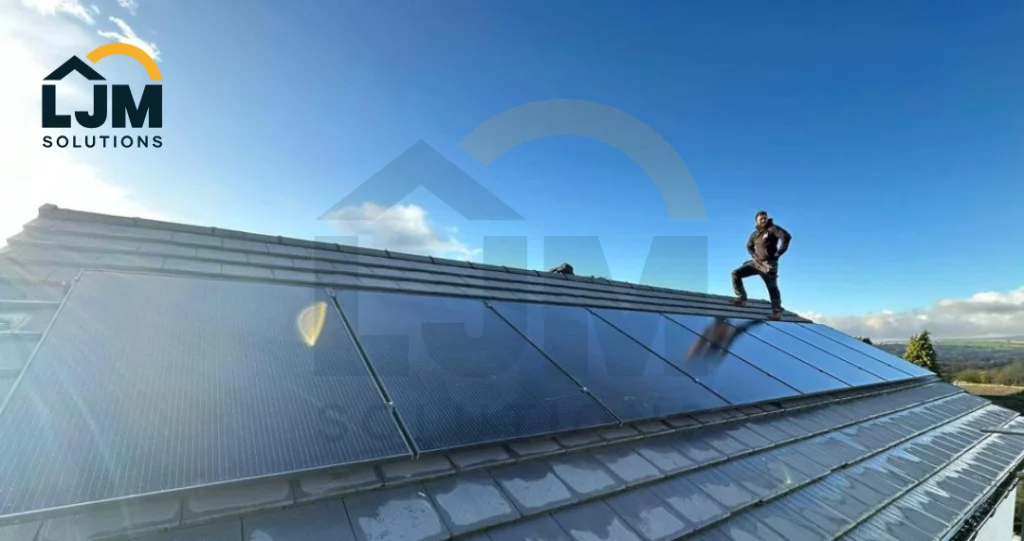
Once you are happy to proceed, our own accredited team carries out the installation. This is worth pausing on, because it is where many solar companies differ.
We handle everything in-house — surveys, design, installation and aftercare, all under one roof. There are no subcontractors on your property and no third parties to chase if a question comes up. You deal with a single, dedicated point of contact who knows your project.
Most domestic installations are completed within a couple of days, though larger or more complex roofs take longer.
Step three: system handover and support
When the system is commissioned we walk you through it — how it works, what the monitoring shows you, and what to expect through the seasons. If a Smart Export Guarantee (SEG) tariff makes sense for you, we can help set it up so you are paid for the surplus you send back to the grid.
After that, our aftercare continues. Friendly, responsive service before, during and after installation is part of what we offer, not an optional extra.
Who is actually on your roof
Accreditations are easy to list and harder to interpret, so here is what ours actually mean:
- MCS certified — the recognised standard for renewable installers in the UK, and a requirement for claiming SEG payments
- NAPIT qualified electrical contractors — competence in the electrical work behind the panels
- TrustMark and RECC backed — government-endorsed quality assurance and the Renewable Energy Consumer Code
- Quality Mark protected — an independent Insurance Backed Guarantee on the work
- CHAS, SSIP and Constructionline Gold — health-and-safety credentials, which matter when people are working at height on your property
- Cyber Essentials — certification covering how your data is handled
You can read more about these on our accreditations page.
Where does the equipment go?
Panels go on the roof, but the inverter and any battery need a home too. They can sit internally — a loft or garage is common — or externally on an outside wall.
Placement is decided during the survey based on the space available and on protecting the components. We will talk you through the options rather than simply deciding for you.
Questions we get asked during installation
What happens in a power cut?
Solar inverters are designed to switch off during a power cut for safety reasons — this protects engineers working on the network. Your panels can continue to work in a power cut if the system is installed with a battery and a relay.
Can I add batteries later?
Yes. You can add additional batteries at any time to store excess electricity created by your panels, and doing so will boost the efficiency of your solar PV system. If you would rather start with panels alone, that is a perfectly sensible route. See our solar and battery storage page for how the two work together.
Can I add an electric car charger?
Yes. We can install an EV charger so the solar energy your system produces can charge your vehicle. If that interests you, mention it when we set up your installation — it is far simpler to plan for at the outset than to retrofit.
What about hot water?
An iBoost diverts surplus solar electricity to your immersion heater instead of exporting it, turning spare generation into hot water.
After the installation
Solar systems are low-maintenance by design. Our panels are built to last 25 or more years with minimal upkeep, and there are no moving parts to service.
What you do get is ongoing support. We are a family-run business incorporated in 2023, though our team brings over 25 years of experience across solar PV, electrical contracting and energy-efficiency work. We are based at Long Eaton in Nottingham and we would rather keep customers than chase new ones.
Ready to start?
The first step is a free site survey, and there is no obligation attached to it. Get in touch and we will arrange a visit.
We install across the East Midlands and nationwide, including Nottingham, Derby, Leicester, Chesterfield and Long Eaton.